
Saint Paul teaches us today about delivering to others what has been received. The gift of the Gospel brings with it the responsibility to proclaim the Gospel to others, which we do through the acts of mercy. But it is a responsibility born of grace: if we are thankful to God—if we are “eucharistic,” which means a life of thankfulness to God for everything we have because everything is gift—then how can it be but joy to share with others the grace we have ourselves received? Mary, after the annunciation, went with joy to Saint Elizabeth, and for both of these women, everything was gift: Jesus was gift to Mary; Mary was gift to Elizabeth; Christ’s presence in utero was gift not only to Saint John Baptist in utero, but was gift to all of them. All was joy; all was gift, and delivering to others what was received.
To live eucharistically is to imitate the Saints in always seeking to deliver and pass on to others what we have received: we have received the innumerable blessings of the Gospel and we are to deliver the Gospel to others around us that they will likewise be blessed by Christ’s mercy, that others partake in this same Life in Christ crucified and risen.
Paul spread the Gospel, despite his sinful background. The same applies for S. Mary Magdalene, a woman filled with seven demons before she met Christ and through Him was purged of her demons: she was so able to share the Gospel of the risen Christ that she is known as an apostle to the apostles. Saint Peter denied Christ three times, yet became the leader of the apostles proclaiming Christ crucified and risen to many lands.
Yet today a great many Christians do not do this. What might hold us back? Something seems to keep us from sharing with others the Gospel light of Christ which we have received. Perhaps one cause is that people have not been taught of the necessity to imitate the Saints in proclaiming the Gospel. And in that case, it cannot be held against them, but rather against the priests of the Church, who are charged to teach their flock. The spiritual literature and wisdom of the Church over 20 centuries indicates an additional cause: having hangups that derive from personal sin. And most commonly in spiritual literature, the sin that is most discussed is pride. Perhaps it is some kind of pride within us that we must overcome in order to share the Gospel with others. Something about pride, and therefore something as well about humility (because humility is the antidote to pride).
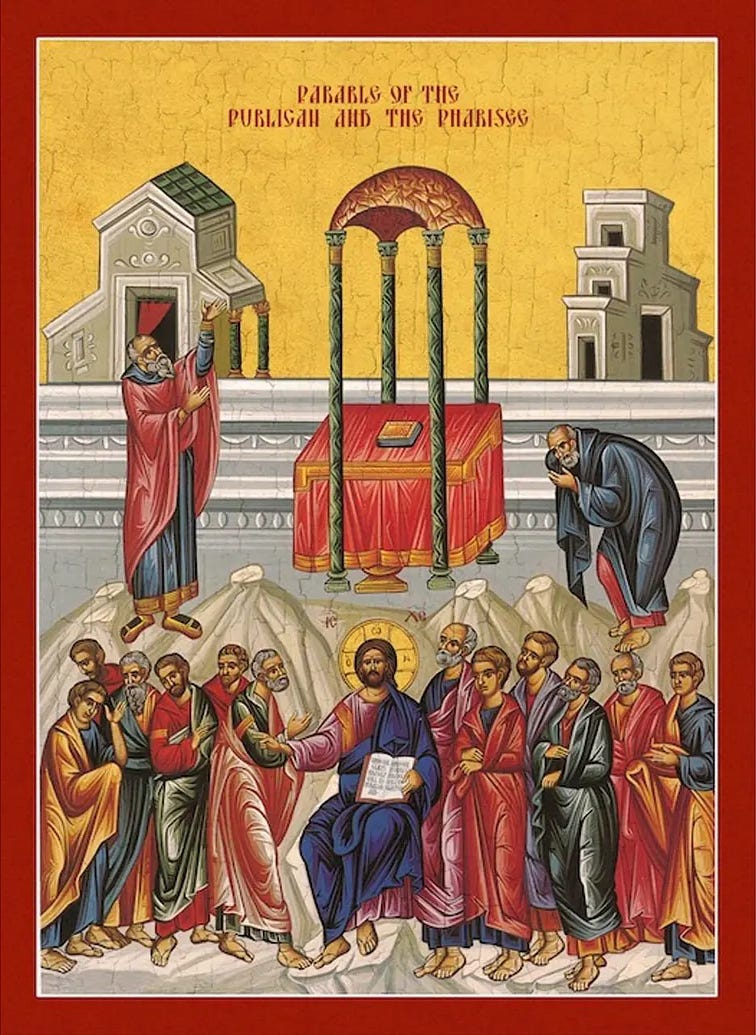
To begin, let us reflect on our Gospel passage. The parable we hear today is that of the Pharisee and the Tax Collector. We are well familiar with this parable. And I want us to reflect on the parable again and do so along with the teaching from Paul. In the Parable of the Pharisee and Tax Collector, we hear of the Pharisee who compares himself to others and finds himself best. In the words of Jesus at the end of the Parable, the Pharisee is the person who exalts himself. The Pharisee judges others and gives himself the prize. The Pharisee is the image of pride.
Our Lord Jesus also presents to us the Tax Collector. The Tax Collector does not even raise his eyes to heaven, and only says, “God, be merciful to me, a sinner.” He judges no one except himself, and again in the words of Jesus, the Tax Collector is he who humbles himself. “Everyone,” Jesus Christ says, “who exalts himself will be humbled, but the one who humbles himself will be exalted.” The Tax Collector is the image of humility. And it is the Tax Collector who proclaims the Gospel.
As we consider this parable, and think about our own lives, we are drawn to say “I will aim to be like the Tax Collector,” and indeed this is what Jesus expects of us. We are to seek to imitate the Tax Collector and in all things regard ourselves with deep humility. Yet as we consider this parable, we might also be drawn to say, “and I will not be like the Pharisee. I will not imitate him. He is not worthy to be imitated.” And while it is understandable to think this way, notice the holy trap our Lord laid for us: in trying to not be like the Pharisee, we unwittingly imitate him, because as the Pharisee looked at the Tax Collector and judged himself better than him, if we regard the Pharisee as a person inferior, we are doing what he does, even as we deride him. Striving to imitate the image of humility tempts us toward pride.
I think what keeps Christians from sharing the Gospel with their neighbors is this kind of pride, the subtle pride of striving outwardly to be like the Tax Collector while secretly thinking ourselves to be special, with a quiet, even invisible, high estimation of ourselves. For us to be able to pass on the Gospel to others, for us to fulfill Christ’s commandment to proclaim the Gospel in our lives to others, we must show ourselves objects of Christ’s mercy and pity. This means having a constant sense of being a sinner; a constant sense of our need for a Savior, a profound sense of the mystery of God, and a deep sense of thanksgiving to God everywhere and in all places which is the eucharistic life.
To truly share with others what we have received, yes, let us imitate the Tax Collector, like him we may long beyond all things for the mercy of God, which gives us peace: “Lord Jesus Christ, Son of God, have mercy on me, a sinner.” This simple prayer inspired by the Tax Collector is the most used prayer by Christians. It recognizes the divine majesty of Christ; it receives the fact of His resurrection; it expresses our need for Christ through true humility; and it asks Him for mercy, which is what we need for salvation, and what we seek to share with others, for sharing mercy is evidence that Christ is resurrected. Lord Jesus Christ, Son of God, have mercy on me, a sinner: Lord Jesus Christ, give us all mercy, O Holy One Who lives and reigns with the Father in the unity of the Holy Ghost, ever one God, world without end. Amen.


