From our patron, the holy apostle Paul, we hear teaching about living in eucharistic community. The Christians in Galatia, as the Church in Galatia which Paul himself had planted, probably in the late 40s, needed to be taught about how to live in community in the Christian way, according to the norms and expectations as revealed in Christ and proclaimed by the Apostles. They needed to be taught, and we today need to be taught; because Christians always have to be taught how to live in community in a Christian way; that is, how to live with and through thankfulness everywhere and in all places, especially when together in a worshiping community. Why do Christians have to be taught how to do this? It is because, like everything else of the Christian reality, the eucharistic reality of thankfulness, of life in Christ as His gift to us, is part of the revelation of God in Jesus Christ. And so, today, we turn again to the topic of eucharistic community: or the revealed life in community around God.
I say “again” because I preached about Christian community ten Sundays ago. There I spoke these words: “In community, we must ever remember that God already knows everyone’s sins, that God already knows everyone’s heart. In community we must ever remember that God is at work in the heart and mind of every person to bring them to repentance, to confession, to humility and honesty before Him. Within the mystery of God is the mystery of trusting Him that He is in control, that unto Him all hearts are open, all desires known, and from Him no secrets are hid.”
There is so much to be thankful for in this. Our God is at work, and His work always arcs toward new creation. What He is doing in us and in others is more than we can ask or imagine. It is because of this that Paul exhorts us to restore anyone in our community who is caught in any transgression in a spirit of gentleness. Gentleness is one of the nine fruits of the Holy Spirit; it is a gift from God, not something we are born with or naturally use. Gentleness comes from the virtue of Love (or Charity in its traditional name). To love fellow Christians who have committed any transgression involves a gentleness toward them, rather than being blunt and heavy-handed. The Gospel of Jesus Christ expects this of us. And when we remember that God already knows the transgression that has been committed, there is no need for anything but gentleness, because God is already at work in the heart of the person.
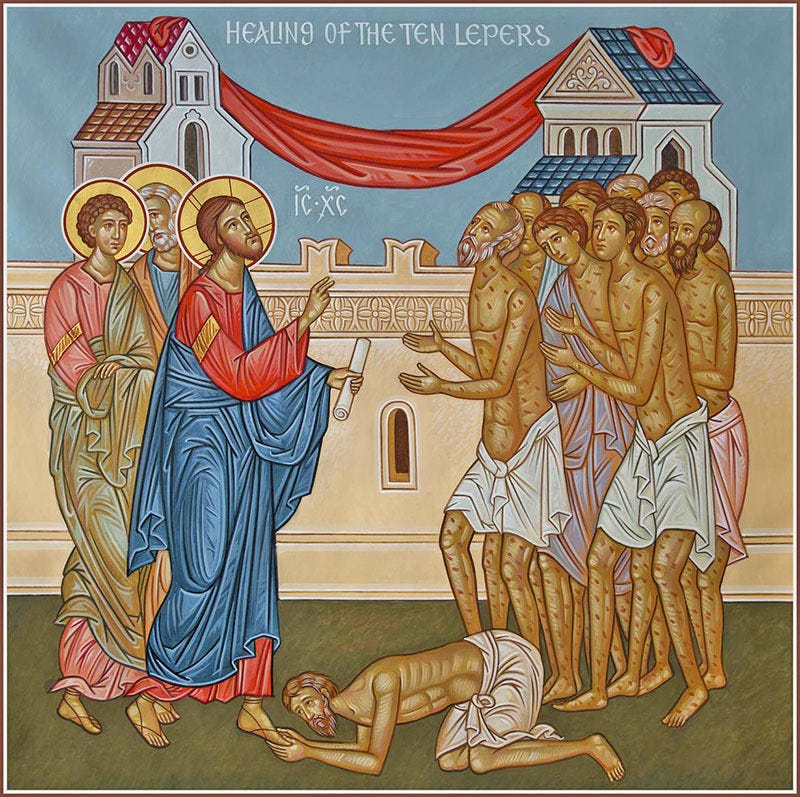
Keeping this in mind, let us consider our Gospel passage. Jesus is met by ten lepers. These lepers ask of Jesus His mercy. We are to do this also: we are to ask Jesus for His mercy, and this is the power of the Jesus Prayer: “Lord Jesus Christ, Son of God, have mercy on me, a sinner.” Our Lord’s nature is mercy and truth, and He is always willing to share His mercy, Himself, with us. But He wants us to ask, for doing so shows us ready to receive, truly yearning for His grace—“Ask, and ye shall receive.” All ten lepers are cleansed, yet nine of the lepers see this transaction as completed. They asked, Jesus gave, they leave; it is over. Except for one—who returns to Jesus, falls on his face at the feet of Jesus, and gives Jesus thanks. Jesus tells us their behavior was not pleasing to God, for He says “Where not ten cleansed? Where are the nine? Was not one found to return and give praise to God except this foreigner?”
The nine lived without thankfulness. They lived non-eucharistically. They received the gift of Christ as a material, physical benefit, not as communion with God. They are not punished in the story, but they are noticed by Christ. He also notices the one who is thankful, who is eucharistic. And being eucharistic, being thankful, is revealed as a matter of personal faith. For Jesus says, “Rise and go your way; your faith has made you well.” To live eucharistically—to live with and by and through thanksgiving as our basic disposition—is a by-product of our faith, which itself is a gift to us from Christ. The tenth leper is thankful, is eucharistic; and in being eucharistic, he gives himself in offering to Christ—he offers and presents to Christ himself, his soul and body, to be a reasonable, holy and living sacrifice to Christ, as taught by S. Paul.
Brothers and sisters, let us recognize, like the tenth leper, that we are being healed by Christ, for this is the salvation He gives to transform us over the course of our Christian journey that begins in this world and continues in the next. And in recognizing what Christ does for us in this world, let us offer ourselves to Him as living sacrifice, like the tenth leper: full of faith, full of thankfulness, full of Christ’s gift, full of awareness of Christ’s boundless gift of Himself to us. To be eucharistic people is our vocation: this is what makes us a “royal priesthood”; for by it we are able to treat others in our community with gentleness and compassion, as well as others in the world, and the world itself. By our thankfulness, by our eucharistic way of being, thankful for everyone and everything around us, especially the difficult and challenging people and things around us, we more and more emulate the perfect eucharistic person: Jesus Christ, Our Lord, Our Redeemer, our Master, Who lives and reigns with the Father in the unity of the Holy Ghost; ever one God, world without end. Amen.


