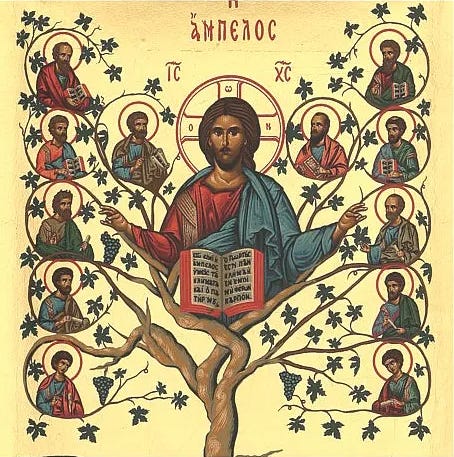
I have been speaking since Trinity Sunday about the Christian life as a eucharistic life. Jesus Christ is the Tree of Life, for He is not only the Way, and not only the Truth, but He is also the Life. And Christ our Life also is a Tree, because, according to the Bride in the Song of Songs (2:3): “As an apple tree among the trees of the wood, so is [Christ], my beloved, among young men. With great delight I sat in [Christ’s] shadow, and His fruit was sweet to my taste.” Christ’s fruit is sweet to our taste, for when we taste His fruit, we see that He is good, we see that He is beautiful, we see that He is true.
The eucharistic life means we feed on Christ, and as we feed on Him, we are enlightened, we are illumined, we are cleansed–or in the words of Saint Paul in our epistle: we are strengthened with power through His Spirit in our inner being, so that Christ may dwell in our hearts through faith–that we, being rooted and grounded in love, may have strength to comprehend with all the Saints what is the breath and length and height and depth, and to know the love of Christ that surpasses knowledge, that we may be filled with all the fullness of God. The more we feed eucharistically on Christ, the more our humanity becomes His sacred humanity in us.
This is what Saint Luke is after in conveying to us in the way that he did the story of Christ, in the town of Nain, bringing back to life the man who had died. Now the literal interpretation of this episode we must respect and honor: Christ in His pity and compassion for a mother brought back a man, her son, who was dead. Upon witnessing this, those around Him glorified God, and we glorify God for this miracle wrought by Christ in His sacred humanity and eternal power.
Yet the Church has always seen in this mighty episode of resurrection from death to life, not only a parallel to the resurrection of Lazarus, but also profound spiritual symbolism. The greatest interpreter of Scripture in our tradition, the Venerable S. Bede, sees the dead man as signifying human beings who are rendered senseless by the deadly destruction of their sinful ways. In the way we have been reflecting this Trinitytide, we would say that the dead man signifies those who are living non-eucharistically. (Those not fed by Christ, those not offering themselves in sacrifice to God out of their thankfulness for God’s immeasurable gift made available to us through the Sacraments and Scripture, those selfish and self-righteous like the Pharisee rather than God-centered and humble like the Tax Collector.)
For Bede, the dead man signifies those dead in Spirit because rather than walking according to the Spirit, they walk according to the flesh. The mother in this story, for Bede and other Church Fathers, represents the Church. She, the mother, as the Church, weeps over the spiritual extinction of her children–and indeed in our day, the Church does weep when those who are baptized fall away from a Christian way of life to a worldly and carnal way of life, and thus risk spiritual death because of their way is not Christ’s way. Christ, again out of His compassion, visits the dead man and revives him; just as Christ, out of His compassion, took on our human flesh so as to redeem us and show us the way to true life, which is life in Him, walking not by the flesh but by the Holy Spirit, our spiritual blindness in spiritual prison giving way to Christ’s light which frees us and liberates us as the children of Israel were liberated from their bondage to Pharaoh in Egypt. For Bede, Christ resurrects the man because of Christ’s presence and visitation: the man’s conscience was touched by fear of divine judgment, and returned to its senses, so that the spiritually dead man swiftly responds to the Saviour Who summons him to life, because Christ’s presence restrains the man’s abundant desire for carnal pleasure, and through inner remorse–that is, through his humility–the sinner is restored to life.
This is why Paul speaks of being strengthened with power through the Spirit in our inner being. The gift of Christ is the power He wants to give our inner being, so as not to live in a non-eucharistic way, but in a eucharistic way. And Paul assures us that this power is real and effectual, for he says Christ is able to do far more abundantly than all that we ask or think. And this is accomplished through His eucharistic word which is our daily bread, which feeds us, nurtures us, and matures us, that we may grow up to the fullness of the stature of Christ through the holiness of our life in Christ: loving God, keeping His commandments, so as to continue in Christ’s holy and eucharistic fellowship, and do all such good works as God hast prepared for us to walk in: through Jesus Christ our Lord, Who lives and reigns with the Father, in the unity of the Holy Ghost, ever one God, world without end. Amen.


