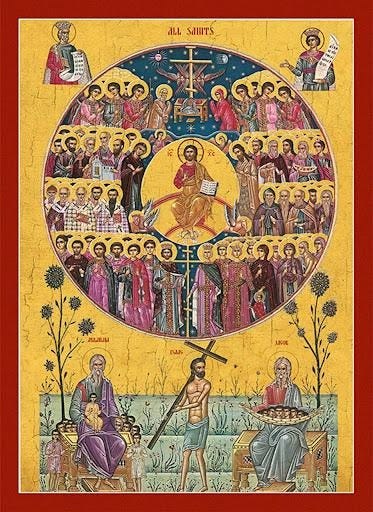
On All Saints’ Day we celebrate the stars that shine brightly in the firmament of heaven. They shine brightly because the Lord apportioned to them great glory. By God’s activity in them, the divine majesty of Christ shines. Today we celebrate those Christians whose names live to all generations in the Church. We celebrate those to whom Christ has revealed Himself in such powerful ways that these Saints became bearers of wisdom, bearers of truth, bearers of how to live according to the way of Christ. Today we celebrate the holy men and women of God, for the Lord is glorious in His Saints, and in them is illustrated and demonstrated the eucharistic life.
That Saints are loved by the whole Church in all of its eras over time is obvious. Just look around at the Christian world: everywhere we see parish churches, cathedrals, monasteries, hospitals, fellowship groups, and more that have a Saint as their patron. Our church under the patronage of Saint Paul the Apostle; our cathedral in Orlando under the patronage of Saint Luke the Evangelist. The oldest parish church in the English-speaking world is in Canterbury, England, under the patronage of S. Martin of Tours (whose day on the Kalendar is next week). York Minster in England is dedicated to S. Peter. Canterbury Cathedral in England has something of a patronage under S. Augustine of Canterbury, who led the re-evangelization of England in the 6th century. In the Vatican in Rome, of course, is the Basilica of S. Peter.
Saints have played a central role in the life of the Church. And this is because Saints are central to Christian experience. If the Saints were not central to the Christian experience, and if active and living communion with them not obligatory upon all Christians, then we would not, in the baptismal creed of the Church called the “Apostles’ Creed,” proclaim a belief in the Communion of the Saints. But the fact of the matter is that we do proclaim our belief in the Communion of the Saints at our baptism. And the Church professes her belief in the Communion of the Saints in the daily liturgy of Matins and Evensong.
This should not be surprising, because it was through a communion of Saints that the fullness of the Church of Jesus Christ–the Church of Christ which was always part of creation itself, the Church of Christ which was revealed in part to the patriarchs and prophets of Scripture (Abraham, Moses, Isaiah, and the rest)–but through the communion of Saints the Church in its fullness is revealed. One hundred and twenty Saints were gathered in the Upper Room, told to go there by Jesus Christ to await the promise of the Father, the Coming of the Holy Ghost. This was the first Church. Gathered in the Upper Room for nine days were Blessed Mary, whom the Church quickly saw as Mother of the Church, along with other holy women, Mary Magdalene, her sister Martha, Mary the wife of Cleopas, perhaps Peter’s mother-in-law; along of course with the Eleven men singled out by Jesus for a particular task, soon joined by Matthias taking over for Judas.
It is sometimes taught that we can understand the Saints as “true friends.” We call a person a “true friend” when we have a living relationship with that person in which both people want the best for each other. The same goes for the Saints. We are truly participating in the Communion of the Saints, as the Apostles’ Creed has it, when the Saints are for us more than names attached to church and cathedrals, more than icons or stained glass images we see in holy places, when they are more than characters in the Gospel story. The Saints are truly for us a great cloud of witnesses that surround us – when we have a living relationship with the Saints, as we do with a true friend.
And this is the case with the Saints in general: while the diversity of the Saints baffles analysis, we can always admire the lives of the Saints. Why? Because in simple terms: Saints are transparent to Christ. Saints are transparent to Christ in their thoughts, their actions, their feelings. Saints have put on the mind of Christ, in S. Paul’s phrase. And this is because they have allowed the Holy Spirit and His power to act in them: Saints teach us what happens when we cooperate with grace. Thought of in this way, there is so much to admire and imitate in the Saints: a true abundance.
They show clearly all the attributes and characteristics of the eucharistic life that have been spelled out in the sermons I have offered since Trinity Sunday. The Saints teach us that thanksgiving and gratitude make up the fundamental disposition of Christian life: an attitude of unceasing thankfulness to God. The Saints teach us that regular reception of the Eucharist is the means of transformation and salvation in Christ: in Holy Communion we participate in Christ’s sacrifice and heavenly banquet. The Saints are ever imitating Christ, Who is the perfect eucharistic person: the virtues we attain, the fruits of the Spirit we have, are all aspects of Christ’s own mind and being. The Saints show us that life in community, which for us means the parish, is the primary arena for our participation in heaven and the primary arena for our encounter with God. And the Saints teach us, in fact they insist, that Christian discipleship is rooted in humility, repentance, and the progressive awareness of the mystery of Christ in us, and we in Him: the Saints all imitate not the Pharisee but the Tax Collector, ever seeking the mercy of Christ in all moments of life. All of the beatitudes read out in our Gospel passage are lived out by the Saints, because their lives were changed by God’s grace. The Saints are living proof that the Gospel transforms people.
Because of the incredible and inspiring witness to the eucharistic life that the Saints offered in their own lives, the Church has always held up the Saints, that in recognizing our fellowship with them, our living communion with them through Christ, the Saints radiate and resonate God’s presence and power to us: the Holy Spirit Who filled them with grace and heavenly benediction flows from their witness and life to us. And hence, knowing that the Lord is glorious in His Saints; that the Saints are transparent to Christ; that the fullness of the faith is preserved in the Saints; and that they resonate the Holy Spirit to other members of Christ’s Body–with confidence in Christ our Saviour, we today ask the Holy Saints of the Church to pray for us, that we made be made worthy of the promises of Christ. Amen.


