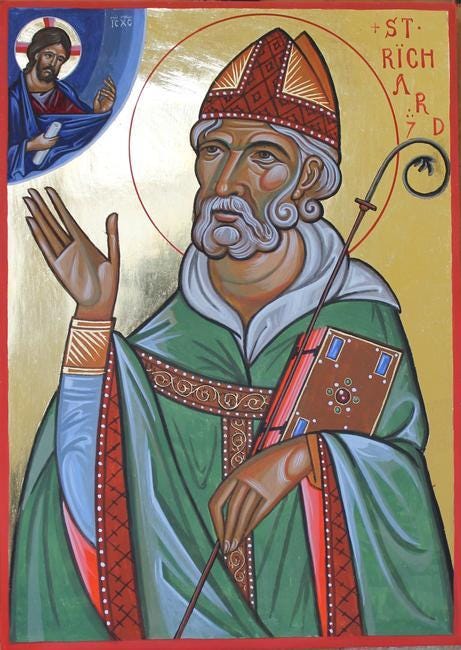
1197 - 1256 | Feast: 3 April
Almighty and most merciful God, Who callest Thy people to Thyself; we pray that, following the example of Thy bishop Richard of Chichester, we may see Thy Son Jesus Christ more clearly, love Him more dearly, and follow Him more nearly; through Jesus Christ our Lord. Amen.
The life of S. Richard follows, as written by Sibyl Harton.
Here is a Saint essentially English, close to us in circumstance and in character, paralleled in our own dy. Richard of Wych was the second son of a wealthy Worcestershire county family, early left an orphan. At his coming of age his brother found that they were much impoverished through the gross mismanagement of their estates, whereupon the intellectual Richard unselfishly delayed his going up to Oxford in order to act as his brother’s bailiff.
With characteristic thoroughness and energy, he studied farming so that he could undertake the improvement of the land. (The love and knowledge of horticulture never left him, and years later in Sussex, when he was debarred from his own avocation, he busied himself with orchards and fruit-grafting.)
When at last he began his studies at Oxford he had to live in great poverty, being defrauded by the priest to whom he had entrusted his property: so poor were the three friends who lived together (before the easy days of government grants to students) that they had only one gown between them and had to take it by turn to attend lectures. But despite all the hardships Richard’s nature expanded in the academic atmosphere, and he later referred to his Oxford years as the happiest of his life.
He then went to Parish, and on to the University of Bologna, where for seven years he studied and taught Canon Law. His fame spread, and he was chosen by the saintly Edmund Rich, Archbishop of Canterbury, to be his Chancellor and secretary. Richard served him with utter devotion, relieving him as far as he could of the turmoil of external affairs, being consistently courteous to those who sought for the Archbishop’s aid; learning from him the while the secrets of a holy life, so that master and disciple leant equally one upon the other. He shared Edmund’s exile in France; after his friend’s death he studied theology in Orleans, where he lived most ascetically until he was there ordained priest. When Richard returned to his own land he became a country parish priest.
When the see of Chichester fell vacant, the Cathedral Chapter and the Archbishop of Canterbury desired to appointment of Richard, but Henry III wanted to fill it with a most unworthy person. Then began one of the familiar struggles between King and Church. Richard went to take counsel with the Pope and was consecrated Bishop, but on his return he found his episcopal manors confiscated and his entry into his cathedral city forbidden by royal command. So the dispossessed Bishop contented himself with living quietly with the parish priest of the fisherman’s village of Tarring, and from there going about among his people, learning their problems and their wants at their own level, ignoring the scorn of the King’s courtiers and the rudeness of royal servants.
His gentle dignity gradually gained recognition and his patience won the day when in 1243 Henry had to give way before the Pope’s thread of interdict, and Richard at last became truly Bishop. And how he blossomed; for he loved hospitality, “his charity was as wide as the halls of his palace.” He encouraged good conversation, keeping a commonplace-book of the gems heard at his table, where the meals were blessed by the Bishop’s grace, “God give us help as He knoweth our wants.” Yet his warm hospitality and gracious manner disguised a personal hidden life of austerity; fasting, vigil, the ground for his bed. His alms-giving was so generous that in a time of dire famine there would have been nothing left to give away had not Richard’s soldier-brother come to live with him and take charge of the household, becoming the bursar of the palace.
Richard essentially had a pastoral heart; he loved to tend the sick, help the miserable, teach and preach to his flock. HIs last year was spent in what would now be termed a mission to the diocese, which he began from his own cathedral; then he journeyed through Sussex and Kent, preaching with such fervour that everywhere crowds came, hung on his words, and responded. He was called to preach the crusade in Westminster Abbey. Back in his own diocese he gave himself no rest, but soon started again on one of his preaching tours. At Dover he did what he had wanted to do for years: he consecrated a church, with a cemetery set aside for the poor, in honour of his beloved patron Blessed Edmund. This fulfilment of his dearest wish he took to be a sign of his approaching death, and lo, the very next day he fell ill of a fever and, though nursed devotedly by his friend the priest Simon of Tarring, he died, joyfully looking forward to going to the Father.
He was buried in his cathedral at Chichester before the altar of Blessed Edmund: such was the renown of his holiness, he was canonised in 1262; and Chichester honours him to this day.