I have been reflecting all summer long since Trinity Sunday about the eucharistic life. And one of the points I have tried to emphasize is that the word “eucharist” itself means thanksgiving. I want to underscore that this morning, and then see how it connects with the Parable of the Good Samaritan.
“Eucharist” is the English form of the Greek word εὐχαριστία, which means thanksgiving or gratitude. The noun derives from the adjective εὐχάριστος, which means “grateful,” and there is a related verb εὐχαριστέω, which means “to give thanks” and “to be thankful” and this is not as a polite acknowledgement, but as a grateful response to a sincere gift. In 1 Cor. 11:23–24, Paul writes that Jesus “took bread, and when he had given thanks, he broke it.” It is in fact Jesus “took bread, and when εὐχαριστήσας (when He had given thanks), He broke it.” Saints Matthew, Mark, Luke, and John use the word similarly in their New Testament writing. By AD 100, the Church is widely using the term “Eucharist” to refer to the ritual consecration of bread and wine in worship, through Church Fathers such as S. Ignatius of Antioch, S. Justin Martyr, and the very early text The Didache.
Let us meditate even closer on the word in connection with Our Lord and Saviour, Jesus Christ. As I just alluded to, at the Last Supper, when the Blessed Sacrament was instituted, Jesus gave thanksgiving to the Father immediately before He identified the bread and cup with His precious Body and Blood. Towards ordinary bread and wine, towards these gifts, Christ’s disposition and actions offer them back to God. In other words, Jesus demonstrates Eucharist; He embodies Eucharist, that is thanksgiving, and within His Eucharist comes the Eucharist for the Church. Christ’s Eucharist, His disposition and action of thanksgiving (of Eucharist) initiates the transformation of the bread and wine to become Himself.
And then Jesus directs His disciples to make this their way of life. “Do this,” Christ says, “for the remembrance of Me,” for the actually making-present again of Me, He says. “Whenever you do this, you proclaim Christ,” Paul says. Therefore “eucharist” names the ongoing response of the Church and the members of the Church: our life is to be a life of gratitude for the gift of salvation given us by Christ. Or in short, our life is to be a eucharistic life. God calls us to this. The eucharistic life is the vocation of man.
The qualities of eucharistic life, furthermore, are named by Paul in our Epistle. The eucharistic life is made distinct and shows itself through love, joy, peace, patience, kindness, goodness, faithfulness, gentleness, and self-control. These are named by the Church the nine Fruits of the Holy Spirit. These show forth, Paul teaches, as we walk by the Spirit, rather than by the desires of the flesh. These nine Fruits outline the Christian vocation of eucharistic life. By these, Christ is shown through us to others. Christ is the perfect eucharistic person. As we imitate His perfect eucharistic virtue, our lives become more virtuous and more prayerful and more filled by caritas: Christian charity, Christian love.
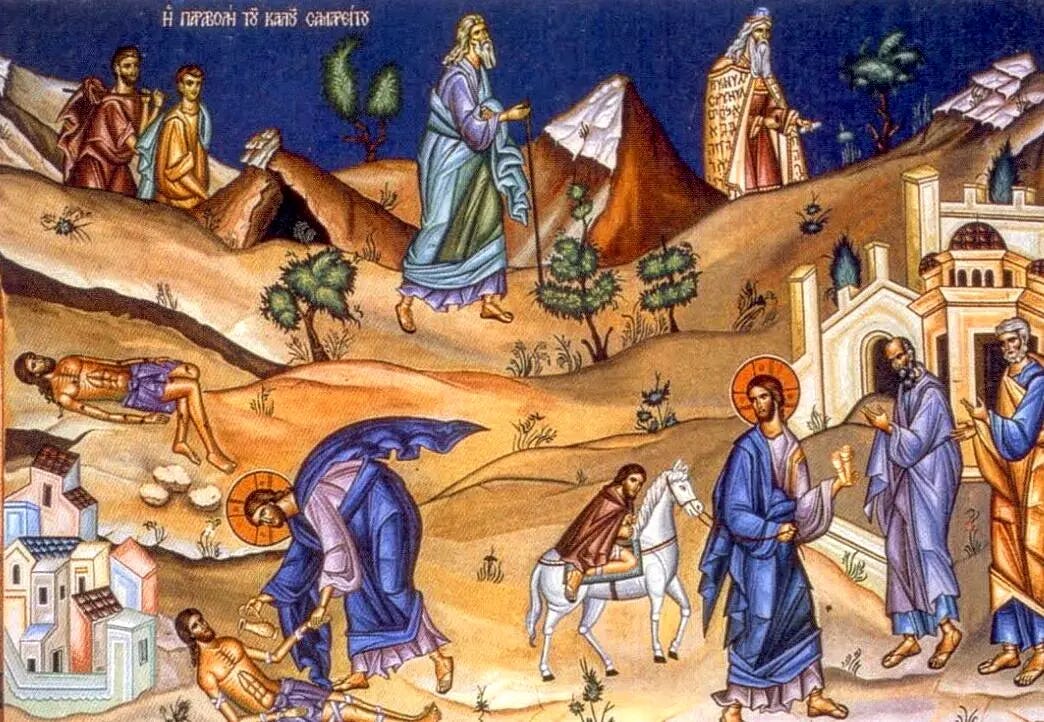
And it is inducing this kind of life, this kind of eucharistic life, that Our Lord is after in his conversation with the lawyer. He tells the parable of the Good Samaritan so perfectly that to His question “Which of these three proved to be a neighbor to the man who fell among the robbers?” the lawyer clearly answers “The one who showed him mercy.” To this, Jesus says, “Go, and do likewise.” But Jesus does not mean, “Go, and do likewise once.” Or twice, or three times. He means as many times as He means when Peter came up and said to him, “Lord, how often shall my brother sin against me, and I forgive him? As many as seven times?” Jesus said to him, “I do not say to you seven times, but seventy times seven.” Meaning, always, every where and in all places. As Jesus taught Peter that forgiveness is to be his way of life, so does Jesus teach us that showing caritas, Christian charity, Christian love to others is to be our way of life—because our life of following Christ is to imitate His virtues. Imitating the perfect eucharistic person which is Christ, we embody a eucharistic life.
In summary, think of it this way. The beaten man is Adam (meaning all of humanity). The robbers are the demons, who because humans give in to temptations, they are robbed of life in Christ. Laying half dead because of sin, he is ignored by people who live by the flesh. To him comes the Samaritan Who is Christ, who heals humanity through His presence and grace (the oil and wine) and brings him to the inn which is the Church and the eucharistic life of the Church. Brothers and sisters, let this be what our lives look like. Let this be our life: which we live in thanksgiving to Christ, our Lord and Savior, Who has healed us and brought us into the Inn of Salvation which is the Church: All for Christ, who lives and reigns with the Father, in the unity of the Holy Ghost, ever one God, world without end. Amen.


